
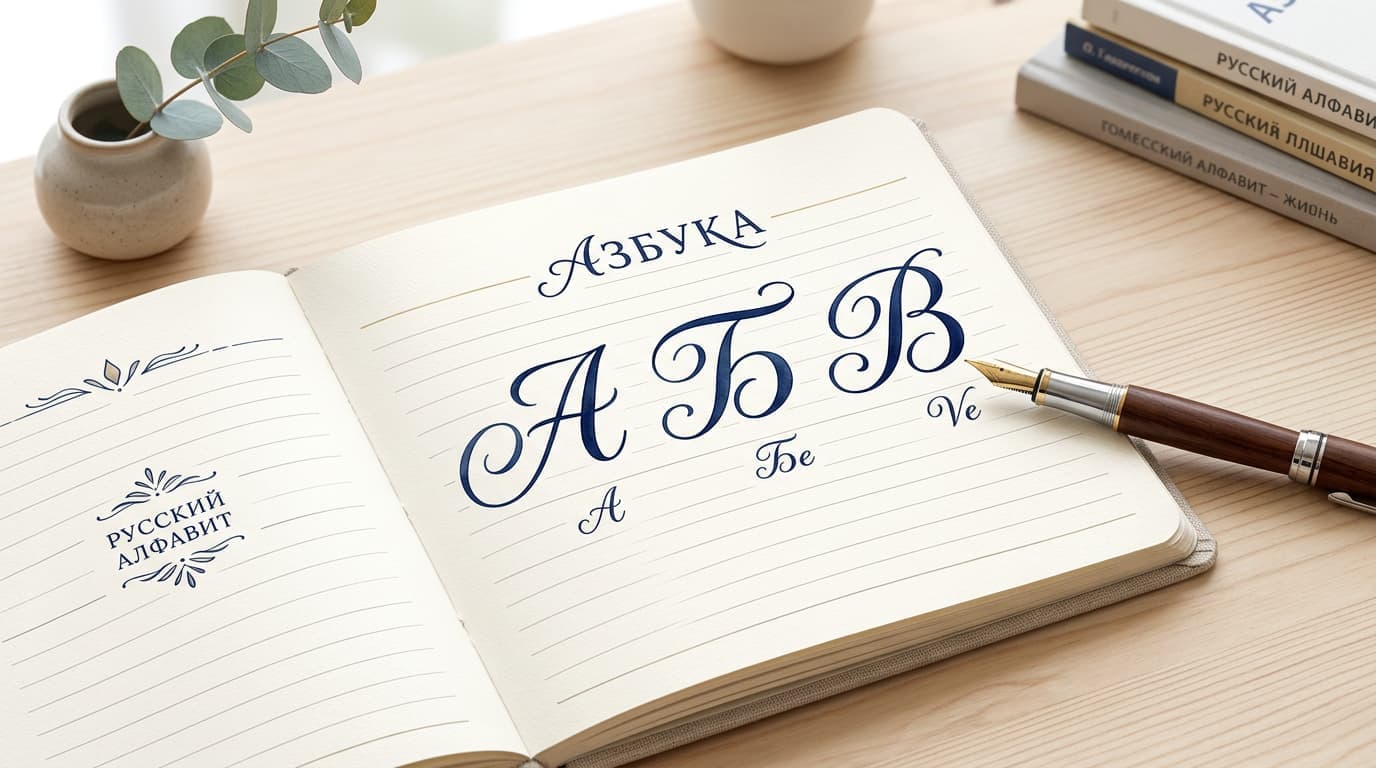

Learn the Russian Alphabet: Every Letter, Sound, Mnemonic & Basic Word
The Russian (Cyrillic) alphabet has 33 letters — and you can learn them all in 2–4 weeks with the right approach. This guide gives you a visual mnemonic, a basic word, and an English sound analogy for every single letter, plus tricks to tell confusing look-alikes apart.
This is your CEFR A1 starting point. Once you can read Cyrillic, everything else — grammar, vocabulary, conversation — becomes dramatically easier.
- All 33 letters with pronunciation, mnemonics, and example words
- Visual tricks to remember every letter (what it "looks like")
- How to tell apart confusing pairs: Л/П, Б/В, Ш/Щ, Ъ/Ь and more
- Vowel reduction — the #1 pronunciation rule in Russian
- Practice exercises and a step-by-step learning plan
The 4 Groups: How to Learn the Alphabet Fast
The Russian alphabet has 33 Cyrillic letters — 10 of which look identical to Latin letters. Start with the "easy" group, then learn the "false friends," then the unique letters. With 15–20 minutes of daily practice, most beginners read Cyrillic confidently in 2–4 weeks.
Don't try to learn all 33 at once. Split them into 4 groups based on how familiar they are to an English speaker. Research shows that chunking new information into groups of 5–7 items is the most effective memorisation strategy.
Group 1: Old Friends (Look the Same, Sound the Same)
These letters look and sound almost identical to English. You already know them.
А а — "a" as in father
- Mnemonic: It's just the letter A!
- Words: арбуз (arbuz — watermelon), автобус (avtobus — bus), Анна (Anna)
- Tip: When unstressed, А still sounds like "a" (unlike О, which changes — see below)
К к — "k" as in kite
- Mnemonic: Looks like K, sounds like K
- Words: кот (kot — cat), кино (kino — cinema), кофе (kofe — coffee)
- Tip: Russian К is never silent, unlike the English K in "knife"
М м — "m" as in mother
- Mnemonic: M is M in any language
- Words: мама (mama — mum), молоко (moloko — milk), Москва (Moskva — Moscow)
- Tip: One of the first words every Russian child learns: мама
О о — "o" as in more (when stressed)
- Mnemonic: A round O — same shape, same idea
- Words: окно (okno — window), озеро (ozero — lake), он (on — he)
- Tip: When unstressed, О sounds like "a"! This is the most important pronunciation rule in Russian. МоскВА is pronounced "Mask-VA," not "Mosk-VO." The stress is on the last syllable, so the О sounds like "a."
Т т — "t" as in table
- Mnemonic: Same T, same sound
- Words: такси (taksi — taxi), телефон (telefon — telephone), торт (tort — cake)
- Tip: Russian Т is always a clean "t" — never the soft "th" sound
Group 2: False Friends (Look Familiar, Sound Different!)
These are the trickiest letters. Your brain sees a familiar shape and assumes the wrong sound. Pay extra attention here.
В в — "v" as in very (NOT "B"!)
- Mnemonic: Think "Valentine" — В looks like a В but says "V"
- Words: вода (voda — water), врач (vrach — doctor), Владимир (Vladimir)
- Hack: If you see В and want to say "B," STOP. It's always "V." The actual "B" sound is Б (which looks like a 6)
Е е — "ye" as in yes (NOT "E"!)
- Mnemonic: Think "Yelena" — the name starts with Е
- Words: еда (yeda — food), есть (yest' — to eat / there is), ещё (yeshchyo — more)
- Hack: At the start of a word or after a vowel, Е = "ye." After a consonant, it softens the consonant and sounds more like "e"
Н н — "n" as in no (NOT "H"!)
- Mnemonic: Н looks like H with a bar moved up — think "No, it's not H!"
- Words: нет (nyet — no), нос (nos — nose), Наташа (Natasha)
- Hack: The real "H" sound in Russian is Х (guttural, like Scottish "loch")
Р р — rolled "r" (NOT "P"!)
- Mnemonic: It looks like P but Rolls off the tongue — think of a pirate saying "RRR!"
- Words: рыба (ryba — fish), работа (rabota — work), Россия (Rossiya — Russia)
- Hack: The actual "P" sound in Russian is П (which looks like a Greek Π / doorway)
С с — "s" as in sun (NOT "C" as in "cat"!)
- Mnemonic: Looks like C but Sings like a snake — "ssss"
- Words: собака (sobaka — dog), солнце (solntse — sun), спасибо (spasibo — thank you)
- Hack: There's no "C as in cat" sound in Cyrillic. С is always "S"
У у — "oo" as in moon
- Mnemonic: У looks like a hook hanging down — "ooh, what's on that hook?"
- Words: утро (utro — morning), улица (ulitsa — street), урок (urok — lesson)
- Hack: This is always a pure "oo" sound — never "yoo" like English "u" in "use"
Х х — "kh" as in loch (guttural, NOT "X"!)
- Mnemonic: Looks like X but sounds like you're clearing your throat — like the Scottish "loch" or German "Bach"
- Words: хлеб (khleb — bread), холодно (kholodno — cold), хорошо (khorosho — good/OK)
- Hack: Think of the "ch" in "Chanukkah" — that's the Х sound
Want a native Russian teacher to correct your pronunciation in real time? The "false friends" are much easier to master with live feedback.
Group 3: New Friends (Unique Shapes, New Sounds)
These letters look unfamiliar, but each has a memorable shape. This is where visual mnemonics really help.
Б б — "b" as in bat
- Mnemonic: Б looks like the number 6 — or a belly with a cap on top
- Words: бабушка (babushka — grandmother), банк (bank — bank), болько (bol'no — painful)
- Hack to tell Б from В: Б (=b) has a flat top shelf ─. В (=v) has two bumps like B. Remember: Бelly = b, Вalentine = v
Г г — "g" as in go
- Mnemonic: Г looks like an upside-down L or a gallows
- Words: город (gorod — city), где (gde — where), газета (gazeta — newspaper)
- Tip: Always a hard "g" as in "go," never soft like "gem"
Д д — "d" as in dog
- Mnemonic: Д looks like a little house — дом (dom) means "house"! The two legs are the foundation, the triangle is the roof. The very first word you'll read: дом.
- Words: дом (dom — house), да (da — yes), друг (drug — friend), дверь (dver' — door)
- Tip: The lowercase д can also be written like a handwritten "g" — don't confuse it with Г
Ж ж — "zh" like the "s" in measure
- Mnemonic: Ж looks like a bug/beetle (жук = zhuk = beetle!) — spread wings and legs
- Words: жук (zhuk — beetle), жизнь (zhizn' — life), женщина (zhenshchina — woman)
- Tip: Think of the "s" in "pleasure" or "vision" — that's the zh sound
З з — "z" as in zoo
- Mnemonic: З looks like the number 3 — and "z" is the 3rd letter from the end of the English alphabet
- Words: здоровье (zdorov'ye — health), здравствуйте (zdravstvuyte — hello formal), зима (zima — winter)
- Tip: This is always a buzzing "z," never an "s"
И и — "ee" as in see
- Mnemonic: И looks like a backwards N — think "eeN reverse"
- Words: имя (imya — name), интересно (interesno — interesting), играть (igrat' — to play)
- Tip: This is a pure "ee" sound — the most common vowel in Russian
Й й — "y" as in boy (short "ee")
- Mnemonic: Й is just И with a little hat (breve) on top — think of it as a short, quick "ee" or the "y" in "boy"
- Words: йогурт (yogurt), чай (chay — tea), мой (moy — my)
- Hack to tell И from Й: И = long "ee" (like in "see"). Й = quick "y" (like in "boy"). Look for the hat!
Л л — "l" as in love
- Mnemonic: Л looks like a tent with its opening on the LEFT. Л = Left = Levo (лево) in Russian! The stick goes up on the left side.
- Words: любовь (lyubov' — love), лампа (lampa — lamp), лево (levo — left)
- Hack to tell Л from П: Л has an angled left leg (like a tent ⋀). П has two straight vertical legs (like a Пortal/doorway). Л = Left, П = Portal
П п — "p" as in pen
- Mnemonic: П looks like a doorway / portal / goal posts — two straight vertical legs with a flat top
- Words: папа (papa — dad), парк (park — park), пицца (pitstsa — pizza)
- Hack: Remember: Р looks like P but sounds like R. П doesn't look like P but IS the P-sound. Confusing? Just think: Пortal = P sound
Ф ф — "f" as in fun
- Mnemonic: Ф looks like a person standing with arms on hips — like the physical pose of someone showing off (F = ph)
- Words: футбол (futbol — football/soccer), фрукт (frukt — fruit), фото (foto — photo)
Ц ц — "ts" as in cats
- Mnemonic: Ц looks like a letter with a small tail at the bottom-right — think "cats" have tails!
- Words: центр (tsentr — centre), цена (tsena — price), пицца (pitstsa — pizza)
- Tip: It's one sound "ts," not two separate sounds — say "cats" fast and drop the "ca"
Ч ч — "ch" as in chat
- Mnemonic: Ч looks like a chair turned upside down (or the number 4 = четыре = chetyre)
- Words: чай (chay — tea), человек (chelovek — person), час (chas — hour)
- Tip: Always a soft "ch" like in "child" — never hard like "k"
Ш ш — "sh" as in shoe
- Mnemonic: Ш looks like a comb with 3 teeth — or a shelf with 3 vertical supports
- Words: школа (shkola — school), шапка (shapka — hat), Шерлок (Sherlok — Sherlock)
- Tip: Ш is a hard "sh" — your tongue is pulled back
Щ щ — "shch" (soft "sh")
- Mnemonic: Щ is just Ш (the comb) with a little tail — the tail makes it softer! "shch"
- Words: щи (shchi — cabbage soup), борщ (borshch — borscht), щека (shcheka — cheek)
- Hack to tell Ш from Щ: Ш = hard "sh" (3 teeth, no tail). Щ = soft "shch" (3 teeth + tail). The tail = softness
Ъ ъ — Hard sign (no sound)
- Mnemonic: Ъ looks like a b with a blocky top — the hard blocker that keeps consonants hard
- Words: объект (ob-yekt — object), съел (s-yel — ate), подъезд (pod-yezd — entrance)
- Tip: Very rare. It separates a consonant from a following "ye/yo/yu/ya" vowel. You'll barely see it
Ы ы — Deep "i" (no English equivalent)
- Mnemonic: Ы looks like a b| — a soft sign (ь) with a stick. The sound is like getting punched in the stomach while trying to say "ee"
- Words: рыба (ryba — fish), сыр (syr — cheese), мы (my — we)
- Tip: Position your tongue low and back, lips spread (not rounded). It's between "ee" and "uh." See our full guide on how to pronounce Ы
Ь ь — Soft sign (no sound — softens the consonant before it)
- Mnemonic: Ь looks like a b without a top — soft and incomplete, like a cushion that softens the letter before it
- Words: день (den' — day), мать (mat' — mother), учитель (uchitel' — teacher)
- Hack to tell Ъ from Ь: Ъ (hard sign) has a blocky top piece. Ь (soft sign) is smooth — no top block. Hard = has a block. Soft = smooth
Э э — "e" as in met
- Mnemonic: Э looks like a backwards C with a tongue sticking out — it's saying "eh?"
- Words: это (eto — this/it), этаж (etazh — floor/storey), экзамен (ekzamen — exam)
- Tip: Pure "e" sound — no "y" before it (unlike Е, which says "ye")
Ю ю — "yu" as in use
- Mnemonic: Ю looks like it has an O on a string — the "y" sound leads into "oo," giving you "yu"
- Words: юг (yug — south), юмор (yumor — humour), юбка (yubka — skirt)
- Tip: At the start of a word = "yoo." After a consonant, it softens and sounds like "u"
Я я — "ya" as in yard
- Mnemonic: Я looks like a backwards R — think "Ya backwards!" Я also means "I" (me) in Russian — the most personal letter
- Words: Я (Ya — I/me), яблоко (yabloko — apple), язык (yazyk — language)
- Tip: Я is the last letter of the alphabet. In Russian culture, they say "Я — последняя буква алфавита" (I is the last letter of the alphabet) — meaning don't be selfish!
Visual Cheat Sheet: Confusing Pairs
These pairs trip up every beginner. Here are quick tricks for each.
Б (b) vs В (v)
- Б has a flat shelf on top ─ → belly
- В has two bumps like English B → Valentine
- Word test: брат (brat — brother) vs врач (vrach — doctor)
Л (l) vs П (p)
- Л has an angled left leg (tent shape ⋀) → Left
- П has two straight legs (doorway shape) → Portal
- Word test: лампа (lampa — lamp) vs парк (park — park)
Ш (sh) vs Щ (shch)
- Ш = 3 teeth, no tail → hard "sh"
- Щ = 3 teeth + a tail → soft "shch"
- Word test: школа (shkola — school) vs щи (shchi — cabbage soup)
И (ee) vs Й (y)
- И = no hat → long "ee" (like in "see")
- Й = hat on top → short "y" (like in "boy")
- Word test: имя (imya — name) vs йогурт (yogurt)
Ъ (hard sign) vs Ь (soft sign)
- Ъ has a block on top → hard blocker
- Ь is smooth → soft cushion
- Word test: объект (ob-yekt) vs день (den')
Р (r) vs П (p) — the classic trap!
- Р looks like P but = rolled R
- П looks like a doorway but = P sound
- Remember: in Russian, shapes and sounds don't match English expectations!
Н (n) vs English H
- Н = always "n" — НЕТ (nyet — no)
- The Russian "h" sound is Х — a guttural sound from the throat
Е (ye) vs Э (eh)
- Е = "ye" → has a "y" before the sound
- Э = pure "eh" → backwards C, no "y"
- Word test: еда (yeda — food) vs это (eto — this)
Most learners find that the "false friends" group (В, Е, Н, Р, С, У, Х) causes 80% of early reading mistakes. Spend extra time on Group 2 — it pays off enormously. Explore our Russian lessons for guided practice with a native teacher.
Vowel Reduction — The #1 Pronunciation Rule
This single rule will fix 50% of your pronunciation mistakes:
When О is not stressed, it sounds like "a."
| Word | Stress | How О sounds | Pronunciation |
|---|---|---|---|
| молоко́ | last syllable | first two О's → "a" | "ma-la-KO" |
| хорошо́ | last syllable | first two О's → "a" | "kha-ra-SHO" |
| Москва́ | last syllable | О → "a" | "mask-VA" |
| до́м | first syllable | О stays "o" | "DOM" |
Similarly, Е when unstressed sounds closer to "i":
- молоко → ma-la-KO (not mo-lo-ko)
- телефо́н → ti-li-FON (not te-le-fon)
If you only remember one rule from this entire article, make it this one. Vowel reduction is what separates "textbook reading" from sounding natural.
Practice: Read Your First Russian Words
Now let's put it all together. Try reading these common words. Cover the pronunciation and test yourself.
5 Easiest Words (all letters from Group 1)
| Word | Meaning | Pronunciation |
|---|---|---|
| мама | mum | MA-ma |
| кот | cat | kot |
| том | volume/tome | tom |
| атом | atom | a-TOM |
| мак | poppy | mak |
10 Words With False Friends
| Word | Meaning | Pronunciation | Watch out for |
|---|---|---|---|
| нос | nose | nos | Н = n, not h |
| вот | here (is) | vot | В = v, not b |
| рот | mouth | rot | Р = r, not p |
| сон | dream | son | С = s, not c |
| ухо | ear | U-kho | У = oo, Х = kh |
| нет | no | nyet | Н = n, Е = ye |
| река | river | ri-KA | Р = r, Е = ye |
| ветер | wind | VYE-ter | В = v, Е = ye |
| сестра | sister | sis-TRA | С = s |
| хорошо | good | kha-ra-SHO | Х = kh, all О's |
10 Words With Unique Letters
| Word | Meaning | Pronunciation | New letter |
|---|---|---|---|
| дом | house | dom | Д |
| друг | friend | druk | Г |
| зима | winter | zi-MA | З |
| лампа | lamp | LAM-pa | Л |
| папа | dad | PA-pa | П |
| чай | tea | chay | Ч |
| школа | school | SHKO-la | Ш |
| язык | language | ya-ZYK | Я, Ы |
| юг | south | yuk | Ю |
| жизнь | life | zhizn' | Ж, Ь |
Mastered the letters? The next step is reading and speaking with a real teacher. Get personalised feedback on your pronunciation from day one.
Your 2-Week Learning Plan
Follow this plan and you'll read basic Russian in 14 days.
Days 1–3: Group 1 — Old Friends Learn А, К, М, О, Т. Practice reading: мама, кот, том, мак, атом.
Days 4–7: Group 2 — False Friends Learn В, Е, Н, Р, С, У, Х. This is the hardest part — spend extra time here. Practice: вот, нос, рот, сон, ухо.
Days 8–11: Group 3 — New Friends (first half) Learn Б, Г, Д, Ж, З, И, Й, Л, П, Ф. Practice: дом, друг, зима, лампа, папа.
Days 12–14: Group 3 — New Friends (second half) Learn Ц, Ч, Ш, Щ, Ъ, Ы, Ь, Э, Ю, Я. Practice: чай, школа, язык, юг, жизнь.
Daily Routine (15–20 minutes)
- 5 min — Review yesterday's letters with flashcards
- 5 min — Learn 2–3 new letters (shape + sound + word)
- 5 min — Read simple words containing all letters you know
- 5 min — Write each new letter 5 times (uppercase + lowercase)
Common Mistakes to Avoid
- Reading Р as "P" — It's a rolled R! Россия = "Rossiya," not "Possiya"
- Reading Н as "H" — It's N! Нет = "nyet," not "hyet"
- Ignoring vowel reduction — Молоко́ = "ma-la-KO," not "mo-lo-ko"
- Confusing Б and В — Б = b (flat shelf), В = v (two bumps)
- Skipping the soft sign — День (den') ≠ Ден (den) — the soft sign changes the sound
- Not rolling Р — Practice the tongue trill. Say "butter" fast in American English — the "tt" is close to a single Russian Р tap
Next Steps After the Alphabet
Once you can read Cyrillic:
- Learn basic phrases — start with how to say hello in Russian and how to say thank you
- Tackle grammar fundamentals — Russian cases explained simply is the next big milestone
- Build a study plan — see how long it takes to learn Russian for realistic timelines
- Start speaking — even with just the alphabet, you can read signs, menus, and simple texts
Wondering if Russian is hard overall? Read our guide on whether Russian is hard for English speakers — the alphabet is the easy part!
Remember: Every Russian speaker started exactly where you are now — staring at 33 unfamiliar shapes. In two weeks, those shapes will be as natural as the Latin alphabet. Start today.
Frequently Asked Questions
How long does it take to learn the Russian alphabet?
Most learners recognise and read all 33 Cyrillic letters within 2–4 weeks of daily practice (15–20 minutes/day). The "false friends" group (letters that look like English but sound different) takes the most time. By CEFR A1 standards, alphabet mastery is the first milestone.
Which Russian letters are hardest for English speakers?
The "false friends" cause the most confusion: Р (looks like P, sounds like R), Н (looks like H, sounds like N), В (looks like B, sounds like V), and С (looks like C, sounds like S). The sound Ы also has no English equivalent.
Can I learn Russian without learning Cyrillic?
Technically you can use transliterations, but it's strongly discouraged. Transliterations are inconsistent (Ш can be "sh," "sch," or "š"), they don't show stress, and all real Russian content — books, signs, websites — uses Cyrillic. Learning the alphabet first saves time in the long run.
What's the best way to memorise Cyrillic letters?
Use a combination of: visual mnemonics (Д = house, Ж = bug, Я = backwards R), flashcards with spaced repetition, reading practice with simple words, and writing practice by hand. The key is daily short sessions rather than long cramming.
Ready to practice with a native Russian teacher? Book a free trial lesson and start reading Russian with confidence from day one.